I’ll have more to say in the first Ask Me Anything session on the Black Dahlia case, January 6, 2026, at 10 a.m. Pacific time, on YouTube.
The flurry of interest in the latest claim of a “solution” in the Black Dahlia and Zodiac cases, using Machine Learning/LLMs/AI is more evidence that unsolved murders exert a powerful magnetism on one another in the public imagination. Killings that are separated by many miles, many years and entirely different methods become “related” in the public mind. Are the Black Dahlia and Zodiac cases related? No, they are not, except perhaps in the supermarket media. This is the sort of “Ruined Temples Found on Mars” story we used to see in Weekly World News.Continue reading →
Today is the anniversary of a jury of eight women and four men finding Dr. George Hodel not guilty on two counts of molesting his daughter Tamar. I’ll have more to say about this in the days to come, but I wanted to mark the day.
Steve Hodel is fond of quoting an incomplete transcript of defense attorney Robert A. Neeb Jr. interrogating Tamar.
On the jump, the entire exchange, which tells a different story.
Black Dahlia: Murder, Monsters, and Madness in Midcentury Hollywood, by William J. Mann, Simon & Schuster, 464 pages, January 27, 2026, $31.
Like a game of Clue with an actual cold case to solve, a well-worn list of suspects in the 1947 Black Dahlia killing released 22 years ago continues to provide the “true” crime community and the multimillion-dollar industry that feeds it with endless possibilities for speculation and, occasionally, another book.
Was it the murderous Dr. George Hodel at the Sowden House in a gruesome attempt at surrealist art? Mob nightclub owner Mark Hansen at the Florentine Gardens hiring morgue-trained assassin Leslie Dillon to take care of a troublesome dame? Army butcher Carl Balsiger in a fit of violence?
All of them are fakery and fraud by writers Steve Hodel (the ongoing Black Dahlia Avenger franchise launched in 2003), Piu Eatwell (Black Dahlia, Red Rose, 2017) and Eli Frankel (Sisters in Death, forthcoming in October 2025) who, if they read all of their source material, knew their suspect wasn’t the killer and proceeded anyway. Truth is the first victim for a “true” crime author with hopes of making The New York Times bestseller list and everything that goes with it. Continue reading →
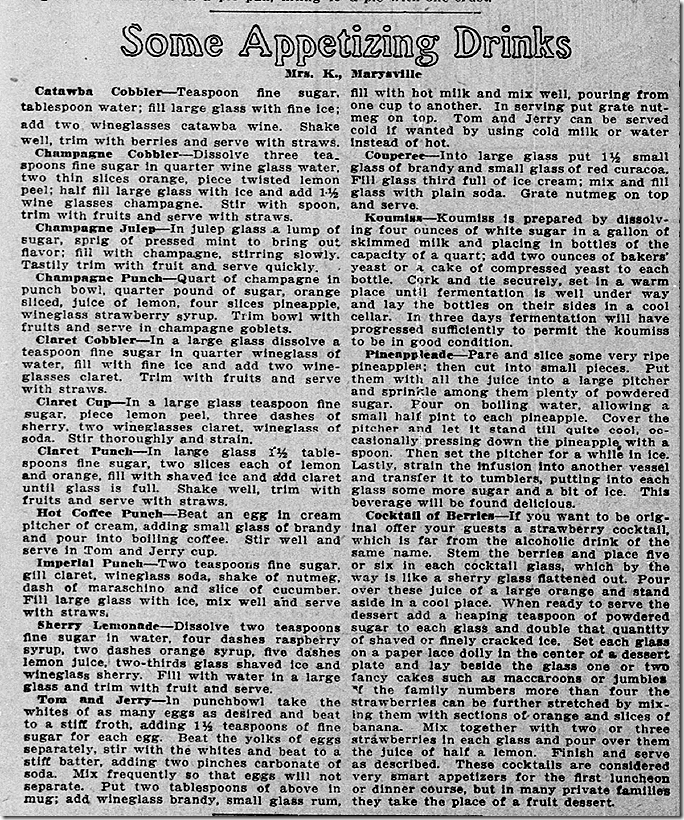
A recipe for the Tom and Jerry from the San Francisco Call, June 30, 1912.
Note: This is an encore post from 2013.
Over on Facebook, Christopher McPherson asked whether the Tom and Jerry was named for the MGM cartoon characters. I said I suspected the opposite was true, rather like Disney’s Chip ‘n’ Dale being named for Chippendale furniture.
All the old newspaper stories give credit for the drink to bartender Jerry Thomas, who according to one account was born in New Haven, Conn., in 1825 (or Watertown, N.Y., in 1830).
On Christmas Eve 1947, the LAPD arrested 35 adults for drunk driving, 2 juveniles for drunk driving, and 19 for being drunk in an automobile. Of the 188 other arrests involving drunkenness, one was for speeding, one was for manslaughter and one was for hit-and-run.
Note: This is an encore post from 2006.
December 26, 1907 Pittsburgh, by direct wire to The Times As Christmas celebrations concluded at Knoxville Presbyterian Church, the congregation presented the Rev. W.A. Jones with $100 ($2,052.36 USD 2005). A banker who was among the worshipers made a point of getting freshly minted gold pieces to present to the pastor. But the $20 Double Eagles, newly redesigned by sculptor Augustus St.-Gaudens at the request of President Theodore Roosevelt, had a terrible flaw, in Jones’ view.
“This is Godless money, I cannot take it,” Jones said of the coins, example at right. “My mother taught me to look for the motto ‘In God We Trust’ on the coins of our country and when the president announced his new order effacing the inscription from the coins, I swore I would take no money that did not bear the old motto.”Continue reading →
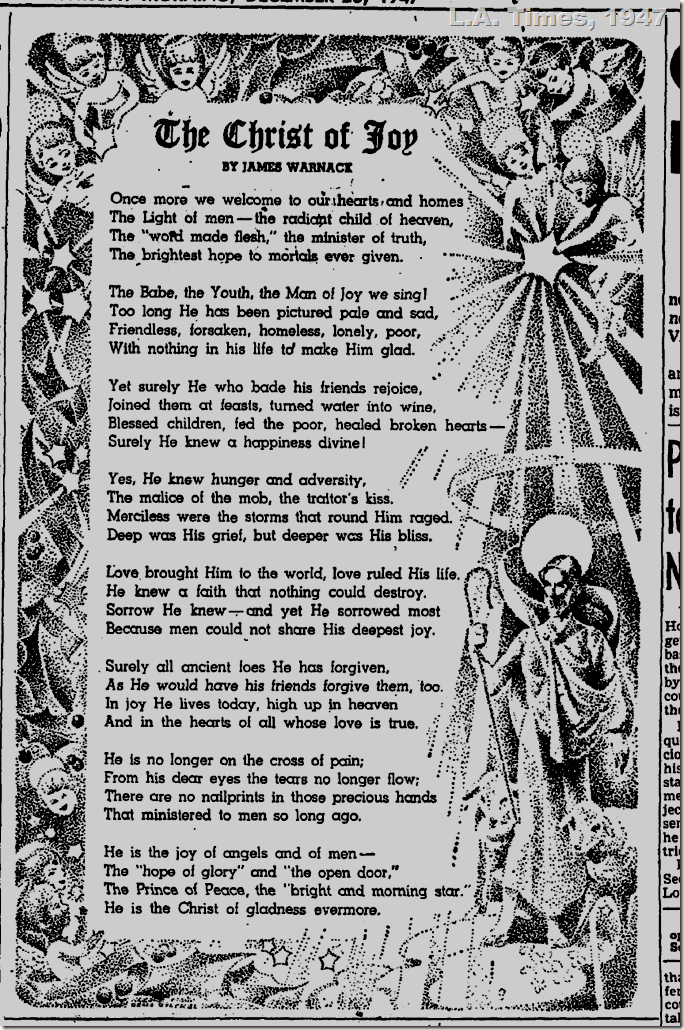
The Times’ front-page Christmas and Easter poems are as forgotten today as their author, James M. Warnack. I’ll leave it to my theological betters to parse the significance of a Christmas poem that’s mostly about the crucifixion, but Warnack was just as contradictory as his work.
He called himself the Foothill Philosopher and was nicknamed around the office as “the Bishop” because of his angular features and long, white hair. An actor in his early life, he appeared in D.W. Griffith’s silent movies, portrayed a priest in the “Mission Play” and Judas in the first “Pilgrimage Play.”
Note: This is an encore post from 2013.
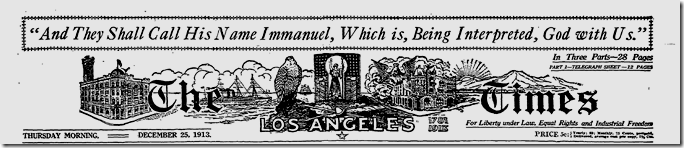
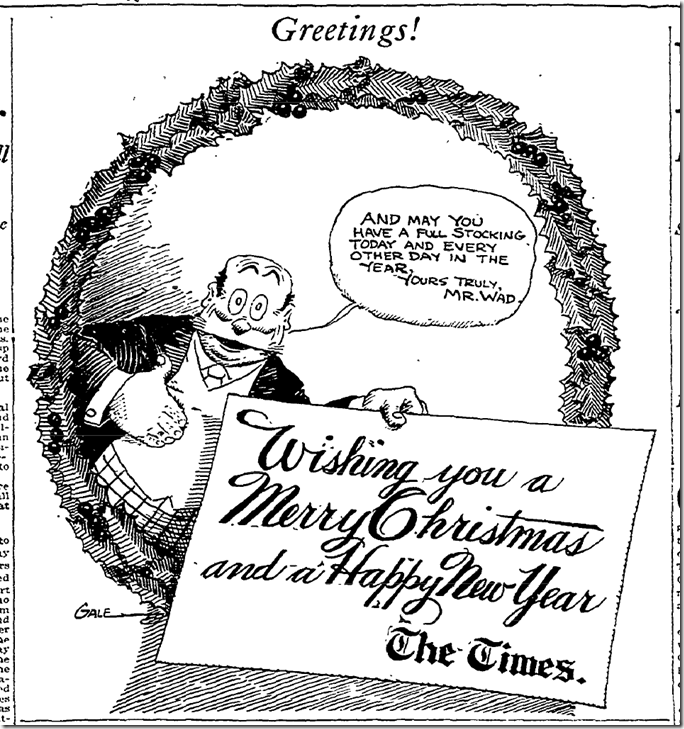
Dec. 25, 1913: The Times carries a biblical passage across the nameplate (notice the artwork of the new and old Times buildings) and a Page 1 cartoon by Edmund Waller “Ted” Gale. “Cartoonist Gale” frequently drew a character known as Miss Los Angeles, but I don’t recall seeing “Mr. Wad” before. Gale was an institution at The Times for many years, but finally quit in a dispute and went to the Los Angeles Examiner. Continue reading →
Jim Romenesko, for those who aren’t in the news business, runs an essential blog that serves as a clearing house for information, gossip, bad headlines and assorted gaffes.
A Jan. 6 postdealt with former Times columnist Al Martinez, who died Monday, and the occasional columns Al wrote over the years about a dying boy who craved peaches.
John Russell of the Indianapolis Star wrote to Romenesko in hopes that some reader would verify Al’s story, saying: “After months of digging, I still can’t find any evidence of the original story, and too many questions to ignore.”
We have some answers — and the story — with a not-so-gentle reminder for reporters: DON’T write from memory or bad things can happen. Use the clips. It’s what they are for. Memory can compress time and erase crucial details, as we will see with Al’s story.
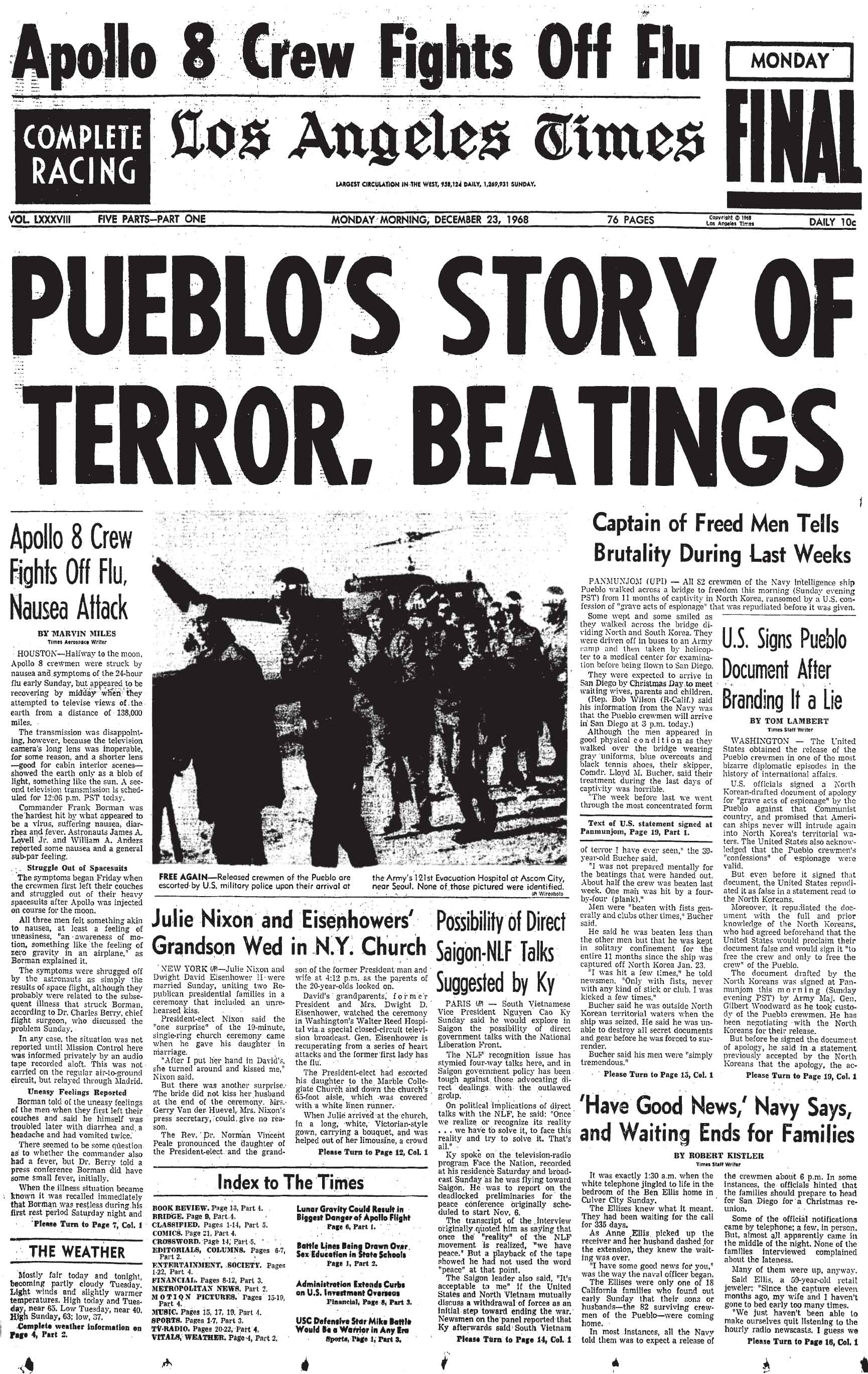
For Pete Bucher, captain of the spy ship, the years haven’t erased the pain of his captivity–or his homecoming. Even medals and a ceremony did not come without a fight.
Saturday May 5, 1990
By RICHARD E. MEYER
TIMES STAFF WRITER
They beat Pete Bucher with gun butts. They kicked him with their boots. They threw him into walls.
“Sonabitchi criminal!” they yelled. “Goddamned liar! Spydog!”
They forced him to his knees. One put a pistol to his ear and cocked it. “Two minutes to sign, sonabitchi!” Quietly, he said: “I love you, Rose.” He said it again. “I love you, Rose . . . ” The pistol clicked.
A ploy, Pete Bucher realized, and he regained some composure. So they beat, kicked and hit him again with their gun butts, in his stomach, head, neck, groin and kidneys. He retched, urinated blood. Continue reading →
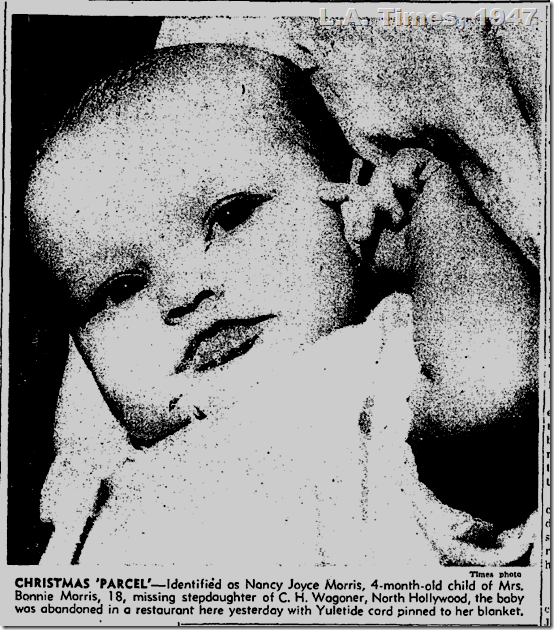
The young mother asked the waitress at the cafe in the Subway Terminal Building to hold her baby for just a moment—and then she was gone.
Four-month-old Nancy Joyce Morris, with light blue eyes and blond hair, was wrapped in a purple quilt and a pink blanket to which her young mother had pinned a Christmas card: To Mr. and Mrs. Robert Lane, 1711 N. Alexandria, with a return address of C.H. Wagoner, 4256 Troost Ave., in North Hollywood. It was signed Bonnie.
St. Louis, via Direct Wire to The Times Dr. Henry S. Atkins, superintendent of St. Louis’ insane asylum, has found that Christmas is a perfect time to test his theory that shopping cures insanity. Atkins and two attendants took 60 women from the asylum “into the world of department stores and the activities which all women enjoy,” The Times said.
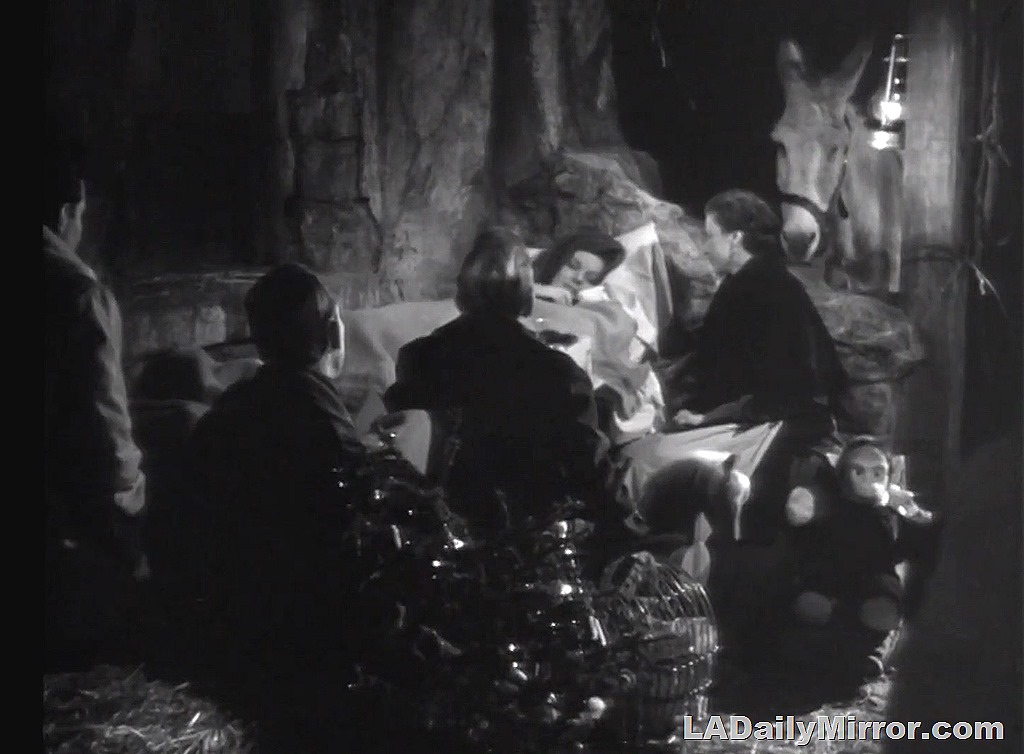
An updated version of the Nativity in Warner Bros. Star in the Night.
Note: This is an encore post from 2021.
Made as a twenty-minute film to complete a program slate for movie theaters, the 1945 Warner Bros. two-reel short Star in the Night provides an understated, moving example of an offbeat contemporary take on the traditional Christmas nativity story. Featuring a much larger budget and more experienced cast than normal for shorts, the powerful featurette proved popular with audiences making it a perennial hit.
While the norm at the dawn of cinema, one- and two-reel shorts came to be seen as just an entertaining morsel or appetizer for the more respected feature film by the 1920s. Providing a training ground for rising talent or work for fading stars, these short films covered the gamut – newsreels, documentaries, travelogues, musical numbers, slapstick comedy, and playlets – offered entertaining product at low prices for local theater owners.
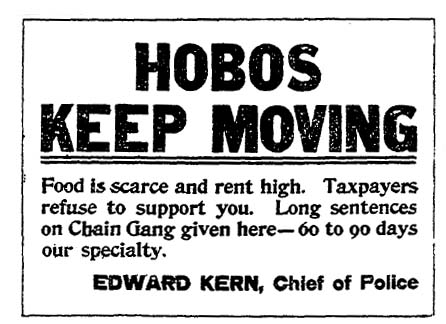
Note: This is an encore post from 2006. Homelessness is a more than century-old problem in Los Angeles — there are no easy or quick fixes. And yes, homeless people were put on the chain gang in 1907.
December 22, 1907 Los Angeles As Police Capt. Flammer approached Yuma, Ariz., to take custody of George White, he noticed the smoke of hundreds of campfires made by hobos burning old railroad ties. The hobos, Flammer learned, were avoiding Yuma because the marshal meted out hard justice to vagrants, as he warned in posters all over town. But Flammer also learned all those homeless men were heading for Los Angeles.
Bonus factoid: The Jewish “defense army” Haganah was reported to have made a major attack—the largest since the U.N. partition decision—against Arabs in Lydda and Bet Nabala, where troops of the Trans-Jordan Arab Legion are camped.
Quote of the day: “For a redhead who worked her way through law school as a floorwalker in a department store and by washing dishes, that’s not bad!” The Times, on Municipal Judge Mildred L. Lillie, whose 1971 nomination to the U.S. Supreme Court by Richard Nixon predated Justice Sandra Day O’Connor by 10 years. When a 12-member bar panel rated Lillie, who had 24 years on the bench, “unqualified” because the men feared a woman would be “too emotional” for the Supreme Court, Nixon withdrew her name in favor of William Rehnquist.
December 21, 1907 Los Angeles Lillian Poelk was new to Los Angeles, with no friends and little more than a job as a waitress that didn’t quite cover the rent of her room at 831 S. Hope. “While other girls were getting pretty things and preparing for a pleasant Christmas, she was shut up in a cheerless room,” The Times said.
And at the age of 55, after dozens of novels and countless short stories, he died. Not that you’ve heard of him or any of his books—unless you collect potboiler novels of the 1930s.
The list of his works is impressive in bulk if nothing else, with titles that tell the entire plot in two or three words: “Dancing Feet,” “In Love With a T-Man,” “Love or Money,” “Modern Marriage” and my favorite: “Short Skirts: A Story of Modern Youth.”
This is the Ask Me Anything on George Hodel and Steve Hodel for December 2025. In this session, I announced the Black Dahlia Book Club, coming in January 2026. The Black Dahlia Book Club will expand the focus of what has been the Ask Me Anything on George Hodel and Steve Hodel to all the magazine articles and books that have been written about the case.
More details to come…. I also discussed: –What is Steve Hodel’s “proof” that George Hodel
knew Elizabeth Short?
–How has Steve Hodel misrepresented Los Angeles history?
–How many places did Steve Hodel live up to the age of 16 or 18?
–Did a
detective tell Jack Webb that the doctor who killed Elizabeth Short lived on
Franklin Avenue?
–Were Steve Hodel and his brothers ever a ward of the state?
–How true are Steve Hodel’s stories about decadent parties at the Sowden
House?
–Did police question George Hodel when he returned from the
Philippines?
–Did Betty Bersinger call the police from the Bayley house to
report Elizabeth Short’s body?
–Steve Hodel’s so-called photos of Elizabeth
Short.
–Where can someone see the Black Dahlia photos that Steve Hodel bought
on EBay?
–What became of the investigation using Buster the Cadaver Dog at the
Sowden House?
–Is it true that the files in the Black Dahlia case are “lost?”
–What is Steve Hodel’s motive in making so many claims about his father?
–Did Steve Hodel get rich from his books?
–Steve Hodel’s claim that he was
part of a “new breed” at the LAPD and the recruiter’s alleged comment that with
the name Hodel he would never work as a cop.










 ladailymirror.com